Prompt Chaining: Teaching LLMs to Think One Step at a Time
March 6, 2026
Hey there! So you’re building AI agents, and you’ve probably noticed that sometimes asking an LLM to do everything at once is like asking your friend to cook a five‑course meal blindfolded – things get messy fast. That’s where prompt chaining comes in. It’s the art of breaking a big task into smaller, focused steps, like following a recipe instead of trying to remember the whole cookbook.
I’m writing this article because I’m on a learning journey myself. I’ve been experimenting with vibe coding, reading dense books, and asking silly questions. And you know what? The silly questions often lead to the best insights. So grab a coffee, and let’s dive into prompt chaining – with real examples, a few laughs, and no academic jargon.
What Is Prompt Chaining? (And Why Your Brain Already Does It)
Think about how you solve a complex problem. Say you’re planning a surprise birthday party. You don’t just think “party” and magically have everything. Instead, your brain breaks it down:
- Pick a date and venue
- Invite people
- Plan the menu
- Buy decorations
- … and so on
Each step depends on the previous one. You can’t send invitations before you have a date. That’s chaining – a sequence of thoughts where each builds on the last.
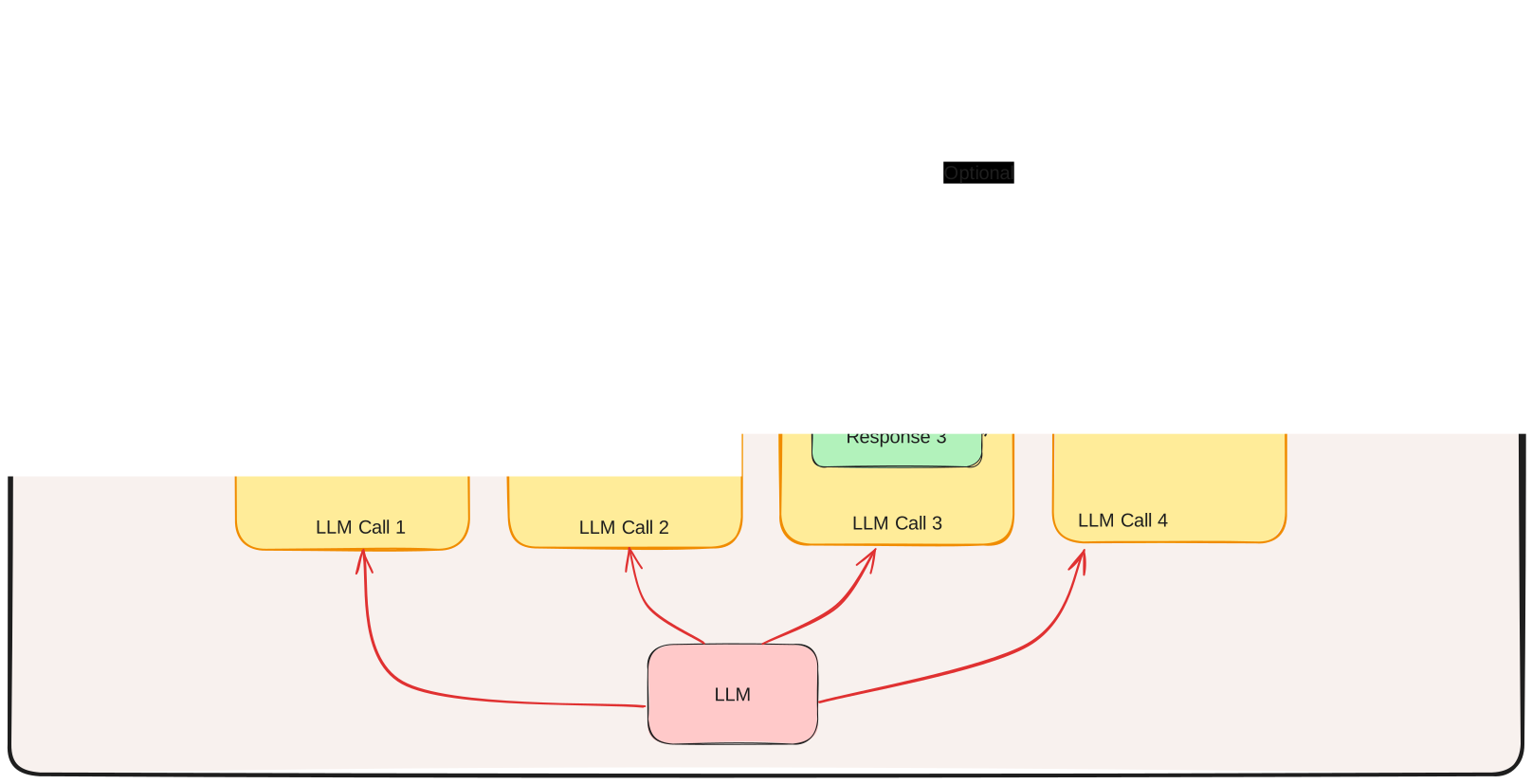
In the LLM world, prompt chaining does exactly that. Instead of one gigantic prompt that asks the model to do ten things at once, we split the work into multiple prompts, each with a single focus. The output of one prompt becomes the input for the next. It’s like an assembly line: one worker attaches the wheels, the next paints the car, the next installs the engine. Each becomes an expert at their step.
Fun analogy: Remember those “Rube Goldberg machines” where a ball rolls down a ramp, triggers a lever, which drops a weight, which finally pours coffee? Prompt chaining is the software version of that – except it actually works, and you don’t need a thousand dominoes.
The Problem with One Prompt to Rule Them All
I once tried to build a full‑stack app with a single prompt: “Write a Django app with user authentication, a dashboard, API endpoints, and a cool UI.” The LLM gave me something that looked plausible, but after two days of debugging, I realised the authentication was broken, the API didn’t return real data, and the UI was a generic mess. Why?
A book I’m reading puts it this way:
“For multifaceted tasks, using a single, complex prompt can cause instruction neglect, contextual drift, error propagation, and hallucinations. The model gets overwhelmed and misses details.”
Let’s translate that into plain English:
- Instruction neglect: The LLM forgets half your requirements because it’s too much to juggle.
- Contextual drift: It starts writing about the database when you asked for the UI, because it lost the thread.
- Error propagation: A mistake in the first paragraph (like a wrong assumption) ruins everything that follows.
- Hallucinations: Under pressure, the model makes stuff up – fake data, non‑existent libraries, you name it.
In short, you’re asking a brilliant but easily distracted assistant to do ten things at once. It will do a few well and the rest poorly.
How Prompt Chaining Saves the Day
Instead of one overloaded prompt, we create a pipeline. Each step has one clear job, a specific role, and (optionally) its own tools. The output is passed to the next step in a clean, structured format.
Let’s revisit my app‑building disaster. Here’s how prompt chaining would have helped:
Step 1: Clarify requirements
Prompt: “I need a task management app with user login, projects, and tasks. What are the core features?”
Role: Product Manager
Output: A bullet list of features.
Step 2: Design database schema
Prompt: “Based on these features, design a PostgreSQL schema with tables and relationships.”
Role: Database Architect
Output: A SQL script or JSON schema.
Step 3: Create API endpoints
Prompt: “Using this database schema, design RESTful API endpoints (GET, POST, etc.) for each resource.”
Role: Backend Developer
Output: OpenAPI specification.
Step 4: Build the UI
Prompt: “Given these API endpoints, create a React component for the task list page.”
Role: Frontend Developer
Output: React code.
Now each step is focused. The LLM doesn’t have to switch between thinking about databases and React components. It gets one task, does it well, and passes a clean result forward.
Key insight: This is exactly like how human teams work – specialists handing off deliverables. The LLM becomes a team of specialists, not a single overworked generalist.
The Secret Sauce: Structured Output
Imagine you’re the frontend developer in Step 4. You get the output from Step 3, but it’s a rambling paragraph: “The API should have a /tasks endpoint that returns a list of tasks, each with an id, title, and status.” That’s fine for a human, but if an LLM has to parse that, it might misinterpret. What if the next step is another LLM? It needs machine‑readable data.
That’s where structured output comes in. We ask each step to return JSON or XML. For example, Step 3 could output:
{
  "endpoints": [
    {
      "path": "/tasks",
      "method": "GET",
      "response": {
        "type": "array",
        "items": {
          "id": "integer",
          "title": "string",
          "status": "string"
        }
      }
    }
  ]
}
Now Step 4 can reliably extract the information. No guessing. No hallucination about what the API returns.
Kitchen analogy: You don’t hand your sous‑chef a pile of mixed vegetables and say “figure it out.” You put the chopped carrots in a labelled container, the diced onions in another. Structured output is those labelled containers.
Real‑World Examples (With a Dash of Humor)
1. Travel Planning (The “Overwhelmed Tourist” Example)
Single prompt: “Plan a 5‑day trip to Paris, including flights, hotels, restaurants, and a daily itinerary.”
The LLM might give you a generic list of tourist spots and a note to “book flights early.” Not helpful.
Chained version:
-
Step 1 (Researcher): “What are the must‑see attractions in Paris in June? Provide a list with locations and typical visit durations.”
-
Step 2 (Travel Agent): “Find flights from New York to Paris for June 10–15, under $800 round trip.” (Uses a flight API tool)
-
Step 3 (Itinerary Planner): “Using the attractions from Step 1 and flight times from Step 2, create a day‑by‑day itinerary that groups nearby sights.”
-
Step 4 (Packing Assistant): “Based on the weather and activities in the itinerary, suggest a packing list.”
Each step builds on the last, and because the output from Step 1 and 2 is structured (list of attractions with coordinates, flight times), Step 3 can create a sensible plan.
2. Market Research Report (The “I Need Numbers” Example)
I built a small script that compared a single‑prompt research report with a chained one. The single prompt gave me a nice story but the numbers were inconsistent – market size changed between sections. The chained approach:
-
Step 1: Gather market data in JSON (size, growth, top players).
-
Step 2: Analyse consumer behaviour.
-
Step 3: Competitive landscape.
-
Step 4: Future predictions.
-
Step 5: Write the final report in natural language, using the structured data.
The final report had consistent numbers, and I could trace every data point back to its source. Plus, if Step 2’s consumer analysis seemed off, I could re‑run only that step.
3. Vibe Coding an App (My Own Pain Point)
Remember my app disaster? With chaining, I’d have caught the authentication bug at Step 2 (database schema) instead of finding it after two days of coding. Each step acts as a validation point. If the database schema doesn’t include a password field, I fix it before writing any frontend code.
When to Chain and When to Keep It Simple
Prompt chaining isn’t a silver bullet. Sometimes a single prompt is perfectly fine.
| Use a single prompt when… | Use prompt chaining when… |
|---|---|
| The task is simple (e.g.,“Translate this to Spanish”) | The task has multiple distinct subtasks |
| You need a quick, creative response | Each subtask requires different expertise or tools |
| The output doesn’t need to be reused | The output of one step is input for another |
| You’re prototyping and speed matters | You need reliability and traceability |
How many steps? Two steps can be enough if they’re truly distinct (e.g., extract data → translate). Three steps often hit the sweet spot. More than five might mean you’re over‑engineering. Use your judgment.
Handling Failures: The “Oops, Try Again” Strategy
I once asked a chained system to generate a diagram from requirements, and the next step couldn’t understand the diagram format. What did I do? I didn’t restart from scratch. Instead, I kept a copy of the original requirements and sent feedback to the diagram step: “The next step found your output too complex. Can you simplify it and focus on these parts?”
This is actually a feedback loop – a more advanced pattern that combines chaining with reflection. But even in basic chaining, you can build in validation:
-
After each step, check if the output contains the expected fields.
-
If not, ask the step to regenerate with a hint.
-
If it keeps failing, use the original requirements as a fallback to produce a “good enough” result.
This is like a chef tasting the sauce at each stage – if it’s too salty, they adjust before serving.
Parallel + Sequential: The Best of Both Worlds
Sometimes you have many similar subtasks that can run in parallel, followed by a sequential synthesis. Think of grading exam papers:
-
You have 100 students, each with marks in Math, Science, English.
-
You want a subject‑wise analysis and then a final report.
You can run parallel chains for each subject (all using the same prompt template, just with different data). Then sequentially combine those analyses into a final report.
This is often called the MapReduce pattern – map over the subjects in parallel, reduce the results into one coherent output. It’s efficient and scalable.
Practical Applications (From the book I am reading)
Prompt chaining isn’t just for fun; it’s used everywhere:
-
Information processing: Summarise a document → extract entities → query a database → generate a report.
-
Complex query answering: Break a multi‑part question into sub‑questions → research each → synthesise the answer.
-
Automated research agents: Crawl articles in parallel → extract key info → collate → synthesise → review → publish.
These are the building blocks of modern AI agents. And the best part? You can start small. A two‑step chain that validates its own output is already a huge improvement over a single chaotic prompt.
Conclusion: Think Like a Human, Build Like a Pro
Prompt chaining isn’t about making things complicated – it’s about respecting how complex tasks should be handled. Your brain does it naturally. Teams do it naturally. Now your LLM can too.
So next time you’re tempted to write a monster prompt, pause. Ask yourself: “Can I break this into steps? What would each step’s role be? How will they hand off information?” You’ll end up with a system that’s more reliable, easier to debug, and – dare I say – more fun to build.
Now go forth and chain those prompts! And if you hit a snag, remember: even a Rube Goldberg machine needs a little tweaking now and then.
P.S. If you want to see the actual code for the examples (without the funny stories), check out the companion repository. But you already knew that. 😉
Github Repo agentic-pattern-lab
References